
When selecting an office chair, which should offer a good balance of ergonomics and durability, test the chair as a complete system. Check the seat height, backrest, seat depth, armrests, base stability, seat adjustment, frame, cover and spare parts. As long as the ergonomic settings remain correct, the chair is of no use. Users, work styles and maintenance concepts should be compared when evaluating the surface finish and the offers of retailers.

Chairs for short meetings, shared workstations and full-day workstations all have different user requirements. List the users’ height range, sitting time, movement etc., the required desk height and whether the chair needs to be cleaned/reconfigured between users.
Measure the finished desk height, knee clearance, chair width, armrest clearance and route through the space. A chair with lots of adjustability is of little use if it doesn’t fit in the space.
Don’t get stuck on just a comfortable seat. You need to determine whether your user needs Lumbar support, seat depth, seat recline, arm rest position, pressure relief or posture support while at a desk. Your supplier should be able to explain how each of the adjustments on a chair affect the user. Review the Hometree furniture product category first to narrow down the office range. For mechanism and fit refer to the Hometree design and development.
It is necessary to place feet on the floor with appropriate angle of knees. The seat must support upper part of legs without pressure on the back of knees. Record the entire adjustment range and not only the sample setting.
Test upright sitting, relaxed sitting and reaching. Check if the backrest supports the respective working position and does not force an unnatural sitting position on the user. Check if the mechanism remains quiet and stable when changing positions by the user.
Ensure the armrests do not prevent the chair from getting close enough to the work surface. Check for the correct height, width, contact point and clear distance. Record the usable range for shared use desks and the maximum number of users it can cater for.
Perform a complete sample test of all components such as the base, casters, joints and contact surfaces. Verify that the chair will roll as intended and not feel loose or uneven. A feature list from a catalogue is not as reliable as a complete sample test. Verify the material choices against the Hometree material quality control. Evaluate the sample against the Hometree product inspection process.
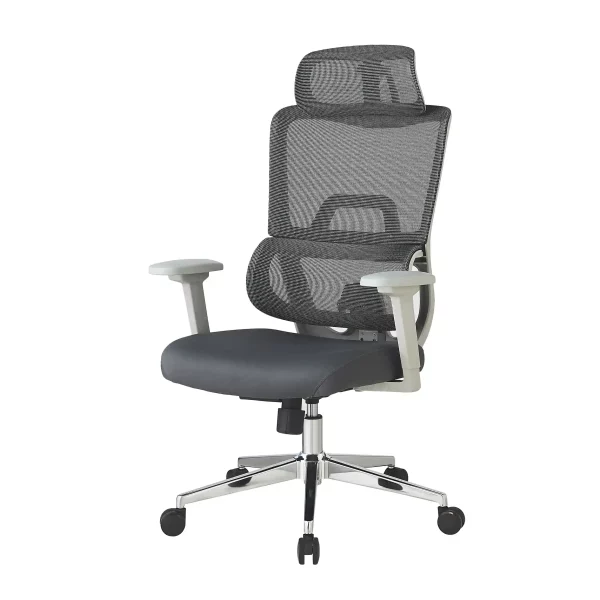
What are the materials of frame, base and connection points? Metal parts should have neat welds and even surface treatment. Our quality inspection dimensions include warping, hardness, surface treatment, fitting, weight, hole positions etc., and overall stability of final assembled product.
Even high-resilience foam needs to be specified by density, thickness and construction. There are big differences between leather, PU, velvet and fabric in terms of cleaning, wear and replacement. So, you need to choose the cover that matches your office.
Ask how the mechanism is tested, which parts can be replaced and how spare parts are identified. A durable chair is easier to keep in service when the supplier can identify the gas lift, caster, arm pad, control and fasteners by part. The supplier’s capabilities are summarized in the Hometree advantage overview. The Hometree furniture FAQs provide a useful starting point for project questions.
A factory should be able to display a processes overview for incoming materials, for components, for assembly, for appearance and for stability. Material is checked by supplier before it leaves the warehouse and again upon arrival in the Hometree factory. All components are subject to process control in terms of measurement for dimensions as well as positioning.
An office chair can get damaged by crushed cartons, exposed upholstery or missing parts. Check the cartons for protection, labeling, assembly instructions and packing of spare parts. Inspect the sample package with the same care as you would inspect the chair itself.
Ask who is handling your technical questions and claims for replacement and after sales, as sales service is handled by a different department to technical engineering for the chairs. Check with the buyer who is handling your inquiry for a specific chair model for the sales service and technical engineering teams’ respective responses and support offered. Supplier review: office chair suppliers in China for reliable performance on ergonomics and cost comparison in performance discussion for China office chairs.
Sample Costs: Include sample cost, unit price, freight volume, assembly time, replacement parts, cleaning and expected return handling. The cheapest chair can cost more than the priciest if users reject it, parts are unavailable or cartons arrive damaged.
Place a small number of chairs in a simulated work environment and ask people to sit down and tell you about their experiences with comfort, adjustment, noise, sturdiness and cleaning. Write down any problems with specific models and track how they are fixed in subsequent revisions, scaling up the number of chairs as needed.
Save all of the chair’s dimensions, mechanism, foam, upholstery, color, hardware, carton and points of inspection to use as a single reference point for future reorders of the approved chair, unless changes have been reviewed and sampled again. Contact us via the Hometree contact page for quotations and other technical queries.
Not every user needs to have all adjustments possible. Start with seat height and depth and then check for back support, seat recline, arm rest and desk height based on user’s work style.
Check the frame, base, welds, joints, mechanism, covers, hardware and packaging. Ask for supplier’s inspection plan and replacement part process and test a complete sample in the space where it will be used.
Hometree is a design, build, make, test and serve company providing commercial and residential furniture solutions. We confirm the design, material and test requirements for your specified chair project.