
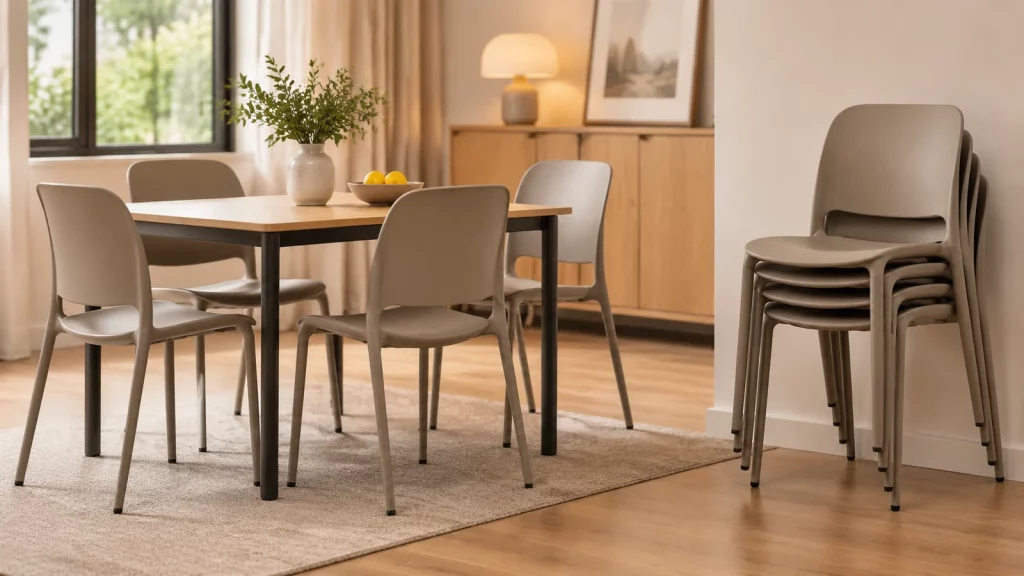
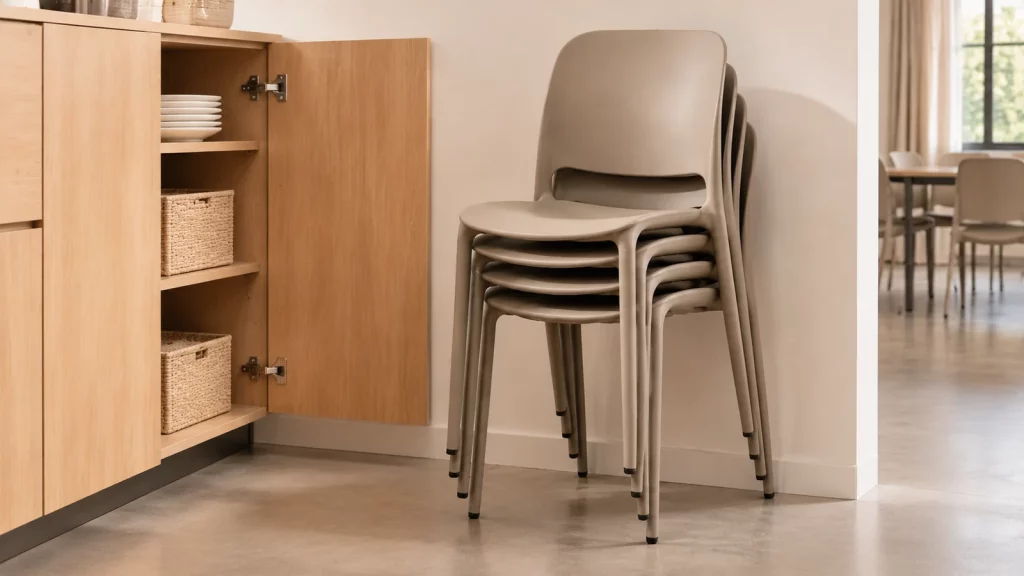
The chairs fit comfortably around the tables. The problem appears at closing time, when the stack leans into a cupboard door and the upper chair is awkward to remove. Stackable chairs need to work through that whole routine: bringing them out, using them, putting them away and retrieving them again. For retailers, distributors and project buyers, the storage arrangement deserves a review alongside the individual chair. Start with the intended room and handling method, then confirm the stacking configuration for the exact model.
Key takeaways
- Measure the complete stack rather than multiplying a single chair’s dimensions.
- Review the contact points between chairs and the intended stacking movement.
- Confirm limits, handling equipment and storage conditions for the actual model.
Describe the changeover before choosing the chair
A dining room with occasional extra seating has a different routine from a space cleared after every event. Record how often the chairs move, where they are stored and who handles them. Include the route between the room and storage: doors, corners, thresholds and the place where chairs are collected before stacking.
This changes the product brief. A chair that is straightforward to stack beside a table may be inconvenient when it must first travel down a narrow corridor. If staff move chairs individually, assess that movement. If a trolley is planned, establish the approved chair and trolley combination before treating it as part of the solution.
Begin with the Hometree furniture range and ask which current models support your intended storage arrangement.
Measure the stack as its own object
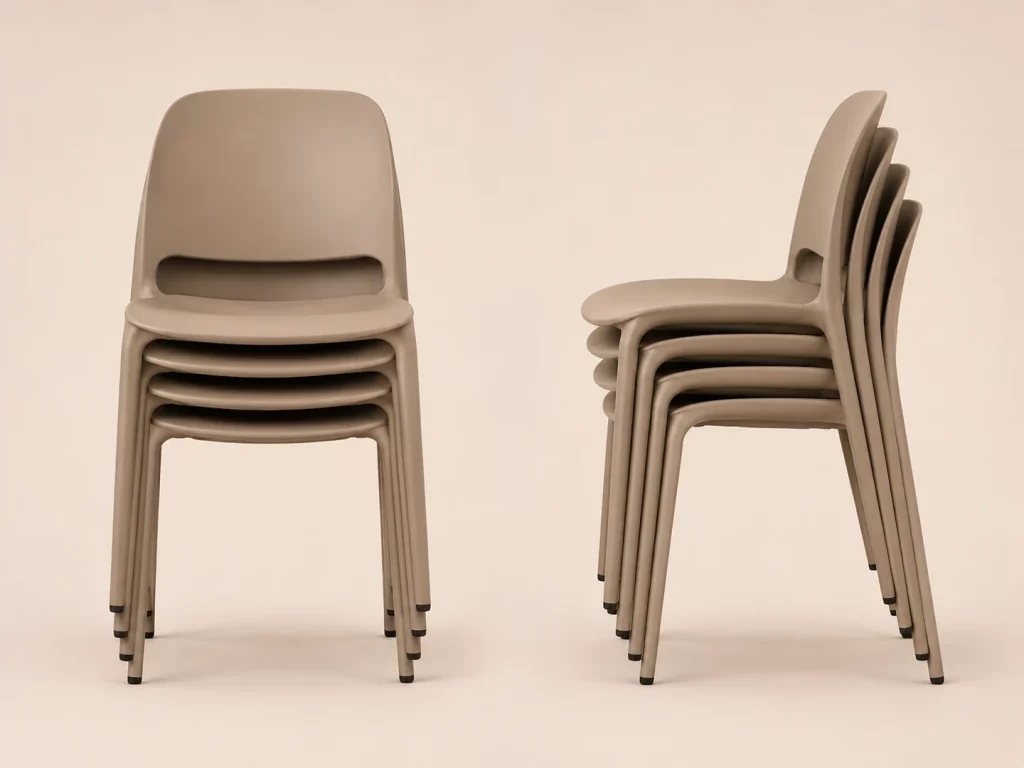
A stack has its own height, width and depth. Some chairs rise mostly vertically; others step backwards or sideways as pieces are added. The storage footprint may therefore be larger than the footprint of the chair standing alone. Request measurements for the intended stack configuration, including any trolley or base used beneath it.
Mark that footprint in the proposed storage position and allow for the space required to approach and remove a chair. Check nearby shelving, door swings and low overhead obstructions. A stack that fits inside a cupboard is not necessarily easy to retrieve from it. Keep storage height and practical access as separate checks.
Confirm the limit for the exact configuration
A catalogue photograph of a tall stack does not establish the permitted quantity. Ask the supplier to confirm the stacking limit, intended conditions and handling instructions for the model and version being ordered. Distinguish a stationary storage arrangement from a stack being moved on equipment; the requirements may differ.
Do not turn the available ceiling height into a stacking limit. The chair geometry, stack alignment and handling method all need consideration. Where the supplier provides a stated limit, use it with the accompanying instructions rather than copying the number into a sales listing without its conditions.
Inspect where one chair meets the next
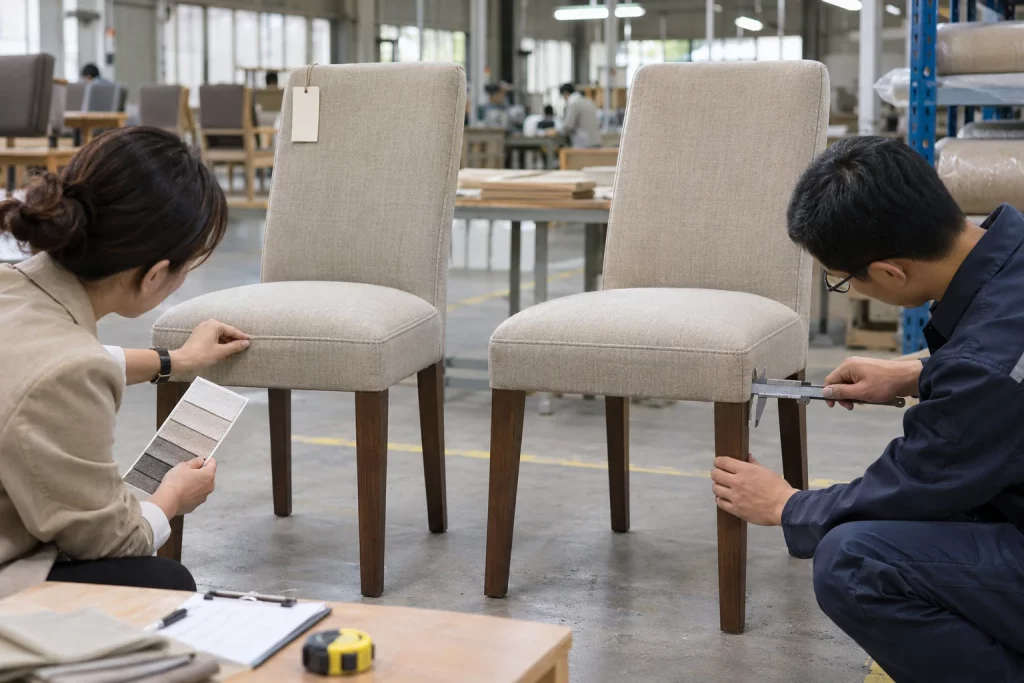
Stack a representative set in the intended way and identify the contact points. Depending on the design, the next chair may rest on parts of the frame, purpose-made spacers or other defined surfaces. Check that the chairs settle into their intended positions without forcing the frames or catching upholstery.
Look at those contact areas again after the agreed stacking demonstration. Record any rubbing, misalignment or unexpected pressure and ask the supplier to review the cause. If protective fittings are part of the design, confirm that they appear in the supplied specification. A good contact arrangement should be identifiable on the furniture, not assumed from a clean product photograph.
Use the product inspection information as a starting point for agreeing what the sample review should record.

Practise removal as well as stacking
The top chair needs to come away in the intended direction without dragging across the chair underneath. Try the sequence with the assembled sample and follow the supplier’s handling guidance. Check the positions of hands, backs, armrests and any fittings that could catch during the movement.
Assess the workflow with the people responsible for it where practical. Record whether the planned routine involves individual chairs or a supplier-approved stack and trolley. Avoid assuming that a chair’s low individual weight makes every combined handling arrangement manageable. The complete movement matters more than a weight figure viewed in isolation.
Keep daily stacking separate from shipping arrangements
A chair may stack in use while being shipped in a different configuration with protective materials. Transport nesting, carton quantity and day-to-day storage should therefore be described separately. Ask what is assembled at arrival, which packing components must be removed and whether the published stack dimensions refer to the ready-to-use furniture.
The same distinction matters when budgeting storage. A warehouse may hold packed chairs while a venue holds an uncovered working stack. Do not use carton dimensions to plan the venue cupboard, or a showroom stack to estimate the shipment. Give each record a clear label so purchasing and operations use the correct figures.
Give the buyer a complete storage record
A useful record identifies the chair model and version, the intended stack quantity, the measured stack dimensions and the approved handling method. Add clear side and rear photographs showing alignment and contact points. Include any specified trolley, spacer or other component needed for that arrangement.
For retail pages, publish only the stacking information confirmed for the version being sold. For projects, compare the record with the actual storage space and changeover route before release. This turns “stackable” from a broad feature into a practical arrangement that the receiving team can understand and repeat.
Include this record in the design and development brief when the stacking arrangement is part of a new product requirement.
Frequently Asked Questions
How many stackable chairs can be stored together?
Use the confirmed limit and instructions for the exact chair and configuration. A photograph, a similar model or the available ceiling height does not establish that number. Also clarify whether the limit describes stationary storage or a stack moved on handling equipment.
Can I calculate stack size from one chair’s dimensions?
Not reliably. The chairs may step backwards or sideways and the additional height per chair depends on their nesting geometry. Obtain or measure the complete intended stack, including its trolley or base, and check access to the storage position.
Can upholstered chairs be stackable?
Some upholstered designs are intended to stack, but the function needs confirmation for the model. Review where the chairs contact each other and whether the upholstery is clear of unintended pressure or catching during the approved movement.
Does a stackable chair ship in its daily storage configuration?
Not necessarily. Shipping may use separate protection, partial assembly or another packing arrangement. Request current carton information separately from the dimensions and instructions for the ready-to-use stack.
Conclusion
Choose stackable chairs around a complete routine, from room changeover to storage and retrieval. Confirm the configuration, measure its occupied space and review contact points and handling with the sample. A clear storage record gives the buyer something more useful than a feature label: a defined arrangement that can be planned into everyday operations.
For current product details, contact the Hometree team.