
What Is the Best Lighting for a Warehouse?
A warehouse is lit so that goods can be found, labels read and trucks driven safely, at the least cost in energy and maintenance.

Illuminance required
The level of illuminance needed depends on the reflectances of the room surfaces and of the goods, on the visual task and on the security needs. Also, because a warehouse may be used at some time for other purposes, the lighting installation should be flexible.
The visual tasks are mainly to find and to read labels, and to drive trucks. Much of the information is conveyed by large letters and numbers, and by the shape of the package rather than by fine detail. It is not usually necessary to see across the whole width of the warehouse, especially when the storage is carried out in aisles between racks. The brightness of the ceiling is not normally important.
Mounting height and spacing
Owing to the height of the building, fittings are mounted high up – at the roof trusses or suspended below the roof. The greater the mounting height, the higher the output of the lamp needed, and this reduces the number of fittings needed.
The spacing-to-mounting-height ratio can vary considerably. If storage is in racks that reach almost to the roof, the luminaires cannot be spread across the width of the room; they are best mounted over the aisles. A typical arrangement is a line of fittings above each aisle.
The colour rendering of the light source is not normally very important in a warehouse, unless it is required to distinguish colour-coded goods and labels.
High-bay fittings
Discharge lamps with high luminous efficacy also produce a great deal of light from a small area, so producing high glare if the lamp is seen directly. Thus the fittings have to be constructed so as to screen the lamp.
A highly polished aluminium reflector is used to direct the light downwards or asymmetrically down the aisles.
If the fittings are mounted high up, the high intensity at the nadir is concentrated into a small area on the floor, especially if the reflector is of a highly specular type.
The two common types of high-bay reflectors are:
– (a) a specular parabolic reflector giving a narrow beam, and
– (b) a dispersive reflector giving a broader beam.
The choice depends on the floor area and on the mounting height and arrangement.
Aisle optics
Fittings designed for aisle lighting are usually long and narrow and fit closely to the line of the aisle.
If the aisle is short, as in the case of a small store, then a fitting designed for general area lighting can be used.
Maintenance factors are normally lower than in offices, and this must be taken into account during planning. In a warehouse there is often a high proportion of dust, and cleaning may not be frequent.
Fittings should be easy to clean and to re-lamp.
Where racking occupies a high proportion of the floor area, the light from fittings above the aisles will bounce off the stock in the racks and provide some vertical illumination in the aisles.
Illuminating the vertical faces of labels is important, especially where the labels are at an angle to the horizontal.
Where the aisles are narrow, the fittings can be mounted at a lower level to be closer to the racks.
Glare
In a warehouse there may be a danger of reflected glare from shiny surfaces such as plastic wrappings.
Direct glare must be controlled, especially at the ends of aisles where high-bay fittings might be seen directly by truck drivers.
Fittings with a low brightness at the angles at which they are seen are recommended.
Glare, uniformity and maintenance must all be considered carefully.
A driver can often be dazzled by light from the other end of the aisle, especially if there are no windows or no other sources of light. If an open doorway or a window is at the far end, the sudden change of brightness can be disturbing.
Controls
In many warehouses lighting is in continuous use throughout the working day. It may be left on during the night shifts or for security.
It is useful to have some means of reducing the lighting when the warehouse is not busy or not occupied, but without plunging it into darkness.
For example, the lighting can be split up by aisles so that each aisle, or each pair of aisles, can be switched independently.
If the warehouse is divided into deep bays, the lighting in a bay can be switched separately from the rest.
Where the installation is large, an automatic system can be used to switch off unoccupied areas; this might rely on the movement of trucks or on humans.
The energy consumed by security lighting can be reduced by having only a few lights on and setting them to switch on automatically at dusk.
Maintenance
The interiors of warehouses, being used for the storage of goods, are not always easy to clean.
The fittings should be enclosed or constructed so as to prevent dust and dirt from accumulating inside them.
Some dirt will inevitably settle, so the fittings should be readily accessible for cleaning.
It is useful to replace lamps (or at least to clean the fittings) at regular intervals. Since high-bay fittings may be difficult to reach, it is often economical to combine cleaning and lamp replacement.
Modern high-efficiency discharge lamps have long lives, but their light output depreciates with age.
The maintenance factor should be planned in advance, and the system of maintenance should take into account the intervals between cleaning, the difficulty of access, the rate at which the light output falls off with age, and the depreciation of illuminance with accumulated dirt.
Furniture finish inspection
Warehouse aisle lighting is not a finish-approval condition. Set aside a smaller comparison area and identify the lamps in use.
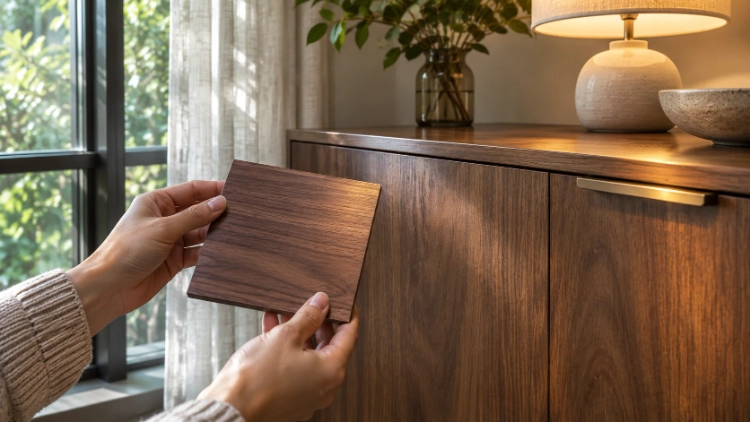
Place the furniture and its physical reference in the same orientation and view both from one position. Angle changes matter on doors, glass and pile fabrics.
Use a neutral background. Move the item or observer if a bright reflection covers the finish. If daylight is part of the approval, repeat the comparison at the agreed window.
Record the Hometree model, finish, reference sample, viewing position and operating lamps. A photograph can support the record but cannot replace the physical comparison. Send the model and lighting details with a pre-order material question.
Conclusion
Plan for safe travel, readable labels and maintainable fittings. Keep finish approval as a separate comparison with a named reference and viewing condition.
FAQ
Can aisle lighting approve a furniture finish?
Use it for an initial look. Final approval needs the agreed lamp, orientation and physical reference, without glare over the finish.
Why can two matching cabinets look different in storage?
Their angle or background may differ. Put both in the same position before comparing them.
What belongs in the inspection record?
Record the model, finish, reference sample, viewing position and operating lamps. Use photographs only as supporting evidence.