

Furniture wholesalers balance design and cost by protecting the parts customers notice and use, then cutting cost from details that add little selling value. Look at material choice, structure, packaging, MOQ, shipping volume, repeat-order consistency, and after-sales risk together. Dining Table HTD0137 is a useful example because its look comes from a clear mix of finish, shape, and structure rather than costly decoration.
Why Is Balancing Furniture Design and Cost Difficult for Wholesalers?
A small design upgrade may seem harmless on one sample. Across a bulk order, the same choice is repeated on every unit. Extra fittings, welding, larger cartons, or difficult finishes can raise furniture production cost quickly.
Evaluate Design Decisions Across the Entire Bulk Order
Do not ask only, “How much does this detail cost?” Ask whether customers can see it, feel it, use it, or pay more for it. If a leg shape gives the table a clear look and also supports the structure, the cost has a reason.
This is where cost-effective furniture design starts. Keep the details that create real value. Recheck the ones that mainly create extra production work.
Calculate Total Cost Instead of Comparing Unit Price Alone
Wholesale furniture sourcing includes more than the factory quotation. MOQ affects stock exposure, carton size affects freight and storage, and poor consistency creates replacements.
Landed cost is therefore a better buying measure than unit price alone. A slightly higher factory price can still be the safer choice if the product packs well, arrives with fewer problems, and can be repeated reliably. This is also why many wholesalers focus on finding reliable wholesale home furniture suppliers before making long-term purchasing decisions.
Which Design Features Should Wholesalers Protect, and Where Can Costs Be Cut?
Not every specification deserves the same budget. Some details drive the sale, while others mainly drive the bill. Your job is to separate them before bulk production starts.
Protect Product Shape, Visible Surfaces, and Daily Function
Customers react first to proportion, color, finish, and silhouette. On a dining table, the top surface, leg shape, size, and stability all affect whether the product feels worth its retail price.
If you want to reduce furniture costs without reducing quality, protect the features buyers can judge within minutes of use.
Match Materials to the Job They Need to Do
A surface material may carry the visual effect, while a metal frame can provide support and shape. Engineered panels can also provide a stable base for decorative finishes.
Before approval, review the available material options and ask one simple question for each part: what job is this material doing?
Simplify Parts, Assembly, and Packaging
Simple furniture does not have to look basic. A well-shaped frame can provide structure and design at the same time.
Packaging belongs in the same decision. Oversized cartons or awkward assembly can raise freight and warehouse costs. Fewer unnecessary parts and cleaner construction can protect both design and cost.
How Should Wholesalers Evaluate Furniture Before a Bulk Order?
A sample should show whether the design can survive real production. Before placing a bulk order, many buyers also review common mistakes when buying dining room chairs for bulk orders to avoid problems caused by wrong specifications, poor quality checks, or unsuitable suppliers. Furniture sample evaluation should cover appearance, structure, dimensions, fittings, finish, assembly, and packaging before a bulk furniture order.
Check Whether the Design Can Be Repeated
Look at details that may drift from one unit to another: hole positions, leg angles, colors, edge finishing, fittings, and overall dimensions. The approved sample only has value if those details can be reproduced.
A sound design and development process helps turn a drawing and prototype into a repeatable production standard.
Compare Visible Quality with Structural Quality
Do not stop at the top surface. Check joints, screws, connectors, alignment, and whether the table sits evenly.
A proper product inspection process should cover surface condition, assembly structure, packaging, and transport protection. That is the furniture quality control needed when volume goes up.
Review Landed-Cost Risk Before Approval
Put the numbers beside the sample. Review MOQ, carton count, packed volume, storage, damage risk, and replacement exposure.
The cheapest sample is not always the cheapest order once packing, freight, storage, and quality risk are added.
How Does Dining Table HTD0137 Balance Design, Cost, and Wholesale Practicality?
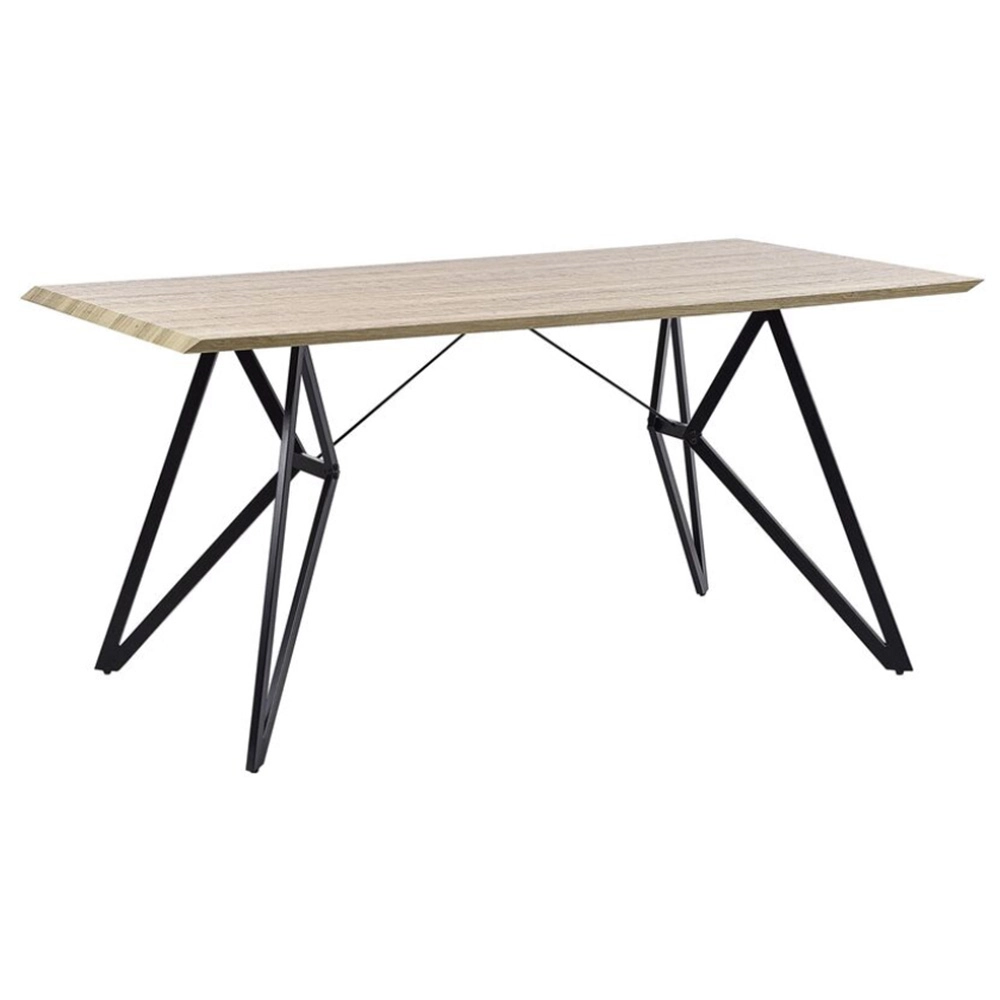
The Dining Table HTD0137 is a good case because the design is easy to read. It uses a warm oak-look top with sharp black angular legs. The listed size is 120 × 80 × 75 cm, the material is MDF + metal, the MOQ is 50 pieces, and the listed volume is 0.087 m³.
Use MDF and Metal for Different Design Functions
Dining Table HTD0137 does not rely on many decorative layers. The tabletop carries most of the visual warmth, while the black metal legs create the modern line and support the table.
For wholesalers, this is a practical cost-effective furniture design approach. Material contrast and geometry do the design work without adding complexity everywhere.
Use Practical Specifications for Order Planning
Dining Table HTD0137 gives you concrete figures to compare before purchase. Its 120 × 80 × 75 cm size, 50-piece MOQ, and 0.087 m³ listed volume can be checked against target retail price, warehouse space, order quantity, and shipping plans.
Those figures matter because wholesale planning is not only about the selling price. A product still has to fit your inventory plan, available storage, shipping method, and expected order turnover.
Reduce Assortment Risk with a Versatile Look
The warm oak-look top and black angular base can fit modern, industrial, casual, or mixed dining settings. That gives Dining Table HTD0137 a wider role than a very specific color or decorative style.
For a wholesaler, a flexible look can make one SKU easier to place across several collections.
How Can the Right Furniture Manufacturer Protect Design, Cost, and Quality?
The design-cost balance is not finished when the sample looks right. The factory still has to repeat the product, hold specifications, inspect the batch, and pack it for export.
Hometree has operated a furniture factory since 2010 and focuses on living room and dining room furniture. Its design, prototyping, production, quality control, and sales teams cover the steps that matter in wholesale projects. That setup helps connect design choices with structure, mass production, inspection, and buyer requirements.
Turn Design Ideas into Repeatable Production Standards
A wholesale design has to work beyond the sample stage. Appearance, materials, structure, components, colors, packaging, and production feasibility all need to be checked before scale-up.
The same logic used in Dining Table HTD0137 applies to custom development: keep what matters to the customer, then make the structure and process repeatable. You can compare related options in the wider furniture product range.
Use Inspection to Protect the Approved Sample
For bulk orders, furniture quality control should catch small issues before they spread across a shipment. Scratches, loose fittings, uneven legs, poor alignment, or weak packaging become expensive when repeated.
That is especially important for repeat orders. Wholesalers need more than one good sample. They need dimensions, finishes, fittings, and construction that remain predictable when another batch is produced months later.
Conclusion
Furniture wholesalers balance design and cost by spending where customers notice value and cutting waste where they do not. Protect shape, visible finish, stability, and useful function. Review furniture production cost together with MOQ, packaging, freight, inventory, and repeat-order risk. Then use furniture sample evaluation and furniture quality control to confirm that the design can be repeated.
Dining Table HTD0137 shows this approach in a practical form. Its MDF + metal construction, warm oak-look top, black angular legs, 50-piece MOQ, and clear size and volume data give you real points to compare before a bulk order. For project support, check the furniture FAQs and contact the team to discuss service, customization, samples, or order requirements.
FAQ
Q1: How Can Furniture Wholesalers Reduce Costs Without Reducing Quality?
A1: Remove unnecessary complexity first. Review extra parts, difficult assembly, oversized packaging, and materials that add little customer value. Keep the parts that affect stability, visible quality, comfort, and daily use.
Q2: Which Furniture Features Should Wholesalers Avoid Compromising?
A2: Protect structural stability, important dimensions, visible surfaces, fittings, and daily-use parts. These areas create more after-sales risk when cost is cut too far.
Q3: Is MDF Suitable for Cost-Effective Wholesale Furniture?
A3: Yes, when it is used for the right function and paired with a suitable structure and surface finish. Judge it by product design, intended use, finish standard, and quality control rather than by material name alone.
Q4: Why Should Wholesalers Calculate Landed Cost Before Ordering Furniture?
A4: Unit price does not include the full commercial burden. MOQ, packing, freight, storage, damage, replacements, and slow-moving stock can change the real cost of a bulk furniture order.
Q5: What Should You Check Before Ordering Dining Table HTD0137 in Bulk?
A5: Check Dining Table HTD0137 for finish consistency, stability, dimensions, leg alignment, fittings, packaging, MOQ, and packed volume. Compare those points with your target market and retail price before approval.