
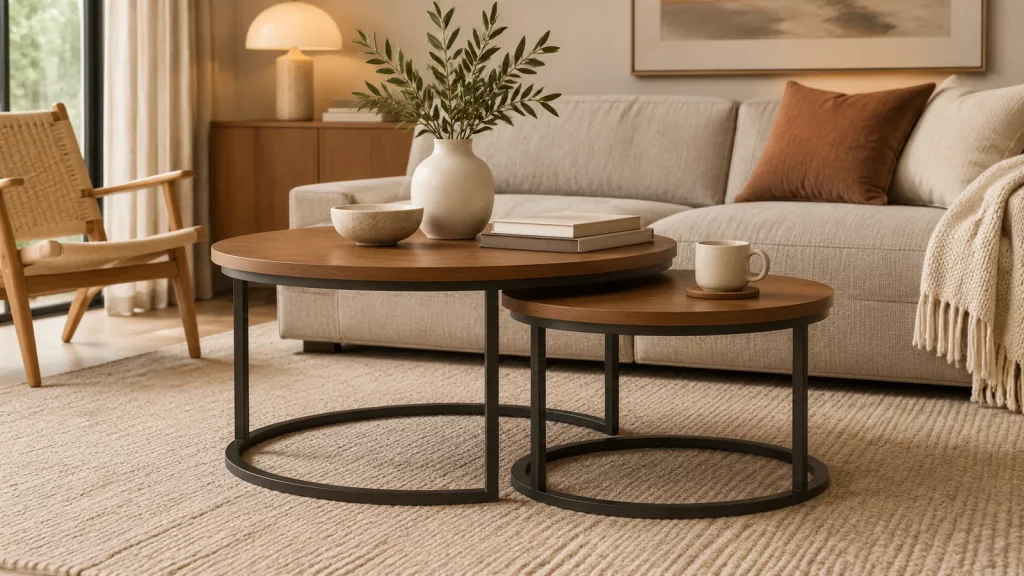
Two tables in a room photograph can look like a nesting set without functioning as one. The smaller top may sit beneath the larger one, yet its base catches when it moves. Or the pair looks balanced together while the smaller piece is awkward to use on its own. Good nesting coffee tables need both arrangements to work. For retailers and designers, the useful question is how the pair changes with the room: overlapping for everyday use, separated when another seat needs a surface.
Key takeaways
- Review the full overlap and separation sequence, including the bases.
- Give each table a clear role when the set is divided.
- Show customers the stored, partially open and separated arrangements.
Decide what the second table adds
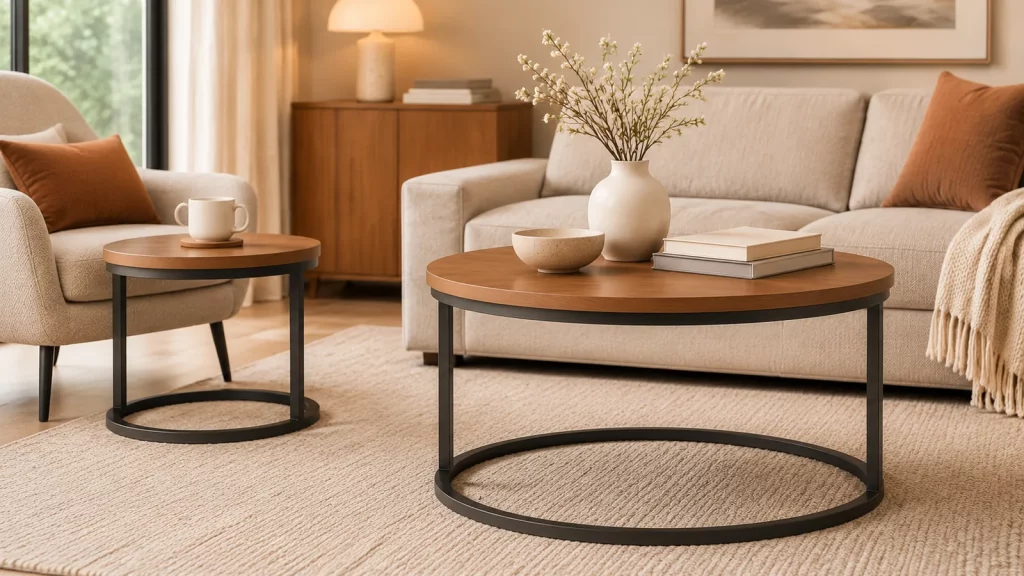
Start with the living-room routine. Does the smaller table provide a temporary surface beside an armchair, serve a second part of a sectional sofa, or remain mostly beneath the larger top? These are different jobs. A retailer can make the product story clearer by choosing one realistic use case and demonstrating it in the display.
Consider a couple who usually uses one central surface but occasionally has guests in an adjacent armchair. A movable second table could be useful there. If both tables always remain at the centre, however, their overlapping arrangement needs to provide enough accessible surface without making everyday objects difficult to reach. The number of pieces alone does not establish flexibility.
Explore the Hometree living and dining range when developing the surrounding collection.
Check what actually nests
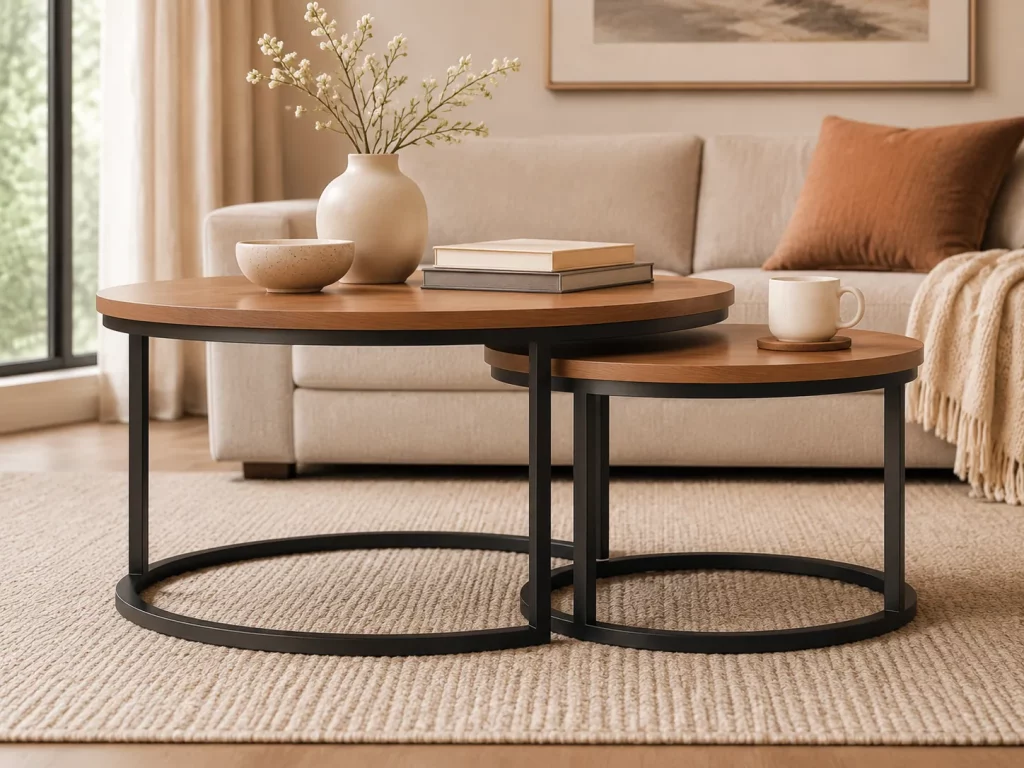
Look below the tops. A smaller tabletop can pass under a larger one while a rail, crossbar or foot prevents the bases from overlapping. Some sets slide deeply together; others overlap only at the perimeter. Ask for the intended arrangement and movement direction, then check it with the assembled pair.
Record the fully nested footprint and the partially open footprint. When the room is tight, that difference may decide whether the second table genuinely reduces the area occupied between uses. Do not describe a pair as fully nesting if the advertised arrangement depends on removing a component or placing it in a position the supplier has not approved.
Give each table an independent job
Separate the pair during sample review. Put the smaller table in its intended position and check whether its top is usable there, its base stands properly and the piece looks complete from the exposed sides. A table whose unfinished rear stays hidden in a nested photograph may not suit a freestanding location.
Judge the larger table alone as well. Removing the smaller piece can expose a broad opening or change the balance of the base. That is not necessarily a design problem, but it belongs in the collection decision. A flexible set should still make sense in the arrangements customers are likely to choose.
For the related question of seated height and reach, read why a coffee table can feel too high or too far away.
Review contact points and movement
Check the route from the nested position to the separate position with the sample empty. Identify whether the smaller piece slides, rotates or needs to be lifted, and follow the supplier’s handling instructions. Inspect the parts that pass closest to each other, including tabletop edges, frame corners and floor glides.
If surfaces touch in the intended arrangement, ask how that contact is managed. Confirm any pads or protective fittings against the supplied specification rather than assuming that a gap visible in a photograph will remain consistent. A two-piece set also needs both bases to be stable in their individual intended positions. Evaluate the furniture on an appropriate level surface and use the agreed inspection procedure.
Make the finishes work in more than one arrangement
A contrasting smaller table can create an appealing accent when the tops overlap. Move it away and check whether the colour and material still work beside the furniture it will serve. The same finish may connect both pieces quietly; contrasting finishes may give each one a stronger individual role.
Review representative samples in the same light and inspect the surfaces revealed by separation. Matching care advice cannot be assumed just because the two pieces are sold as a set. If the materials or coatings differ, obtain the appropriate instructions for each. Keep those distinctions visible in the product description.
Present the set clearly on a retail product page
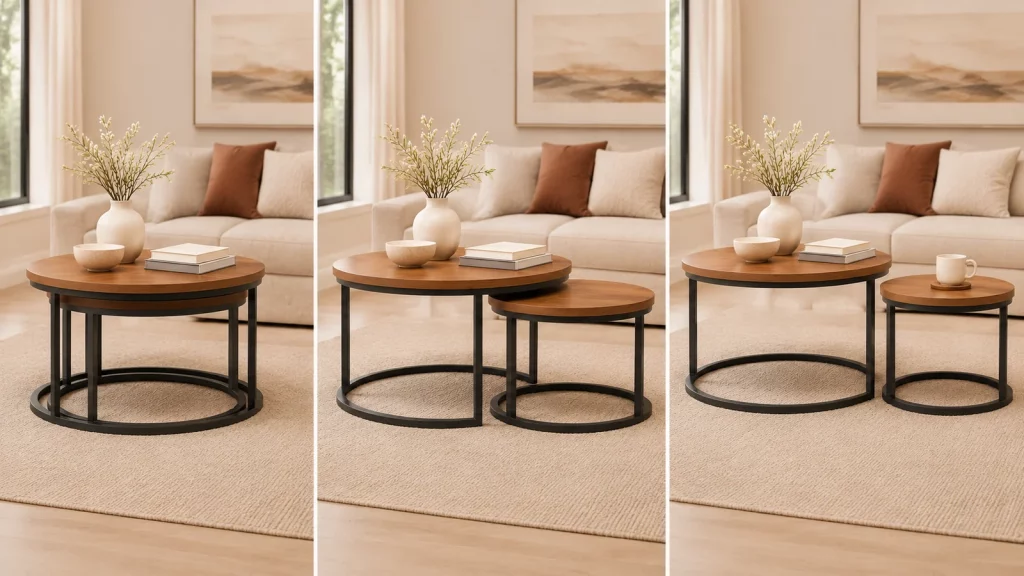
Use one image of the intended nested arrangement, one of the pair opened out, and one showing the smaller table in a separate location. List each piece’s dimensions and explain which dimensions describe the combined arrangement. Make clear whether the purchase includes both tables and whether assembly is required.
Avoid implying that a loose surface is a removable tray, a lower table is a seat or an overlapping design has a locking mechanism unless those functions are confirmed. Good merchandising shows the actual movement and the actual included pieces. It also gives sales staff a simple way to explain why the pair is useful.
Use a three arrangement sample review
Review the pair in three states: nested, partly separated and fully separated. For each state, note the occupied floor area, accessible surfaces and any restrictions on placement or movement. Then photograph the approved arrangements for the product team and showroom staff.
If the set is being developed for a collection, include these arrangements in the brief. A dimension change that improves one configuration can prevent the other from nesting. Reviewing the complete sequence helps keep the design decision connected to the way the product will be presented and used.
Use the design and development process as a starting point for discussing the required configurations.
Frequently Asked Questions
Do nesting coffee tables always save space?
They can reduce their combined footprint when designed to overlap, but the amount depends on the actual bases and tops. Compare the fully nested footprint with the separated arrangement. A pair that overlaps only slightly may offer a different benefit, such as providing two movable surfaces.
Should the smaller nesting table work on its own?
If separate use is part of the product offer, review it independently. Check its intended function, stability, visible finish and suitability for the proposed location. Do not assume it works as a side table simply because it can be pulled away from the larger piece.
Can a nesting coffee table be used as a stool?
Only when that function is expressly supported by the product specification and applicable instructions. A low tabletop can resemble a seat without being designed for sitting. The retail description should explain the approved use of each piece.
What measurements should retailers publish for a nesting set?
Publish the dimensions of each table and identify any quoted combined footprint. Show the arrangement associated with that footprint. Include the pieces supplied and the intended nesting direction where it helps the customer understand the set.
Conclusion
Choose nesting coffee tables by reviewing the pair in motion and each piece in use. A convincing set has a clear overlapping arrangement, useful separate roles and accurate retail information. For a living-room collection brief, share the intended configurations as well as the preferred look, materials and dimensions.
For current product and packing details, contact the Hometree team.