
Choosing between custom furniture and mass-produced furniture is not simply a question of quality or price. The better option depends on what you are buying, how much control you need over the specification, how quickly the order must be delivered, and whether the furniture needs to support a distinctive retail or project concept.
Custom furniture gives buyers more control over dimensions, materials, finishes, packaging and product identity. Mass-produced furniture, on the other hand, starts with a standardized specification that can simplify purchasing when the existing design already meets the requirement.
For retailers, wholesalers, hospitality buyers and interior projects, the real question is therefore not “Which type is better?” It is “Which production model creates fewer compromises for this order?”
Buyers comparing different product options can first review the broader Hometree furniture products range to understand how dining tables, chairs and other furniture categories can serve as either existing product platforms or starting points for customized orders.

The main difference is where the product specification comes from.
With custom furniture, the buyer normally has greater influence over the final specification. Dimensions, materials, finishes, colors, components or packaging may be adjusted around a particular market or project.
Mass-produced furniture begins with a more standardized design. The manufacturer has already defined most of the materials, dimensions and construction details, allowing the same product to be produced repeatedly.
Customization does not always mean designing a piece completely from zero.
A buyer may start with an existing dining table or chair and ask for a different finish, dimension, fabric, metal color or package. Another buyer may provide drawings and require more extensive product development.
The important point is that the final specification changes according to the buyer’s requirement.
For more complex projects, a structured furniture design and development process becomes important. Drawings, 3D models, prototypes, materials, structure, colors and packaging can be evaluated before the specification is finalized for mass production. Hometree’s official process specifically describes moving from design drawings to 3D models and then physical samples before production.
This can be particularly useful for retailers building private-label collections, designers working around specific room dimensions, or hospitality projects that need furniture to follow a defined visual direction.
Mass-produced furniture usually offers less variation because the design has already been standardized for repeat production.
That can be an advantage.
If the dimensions, materials, appearance and packaging already fit the buyer’s needs, there may be little reason to create another specification. Using an established product can simplify sampling, purchasing and replenishment.
The choice therefore depends on whether the existing product fits the business requirement—not on whether “custom” sounds more premium.
| Factor | Custom Furniture | Mass-Produced Furniture |
| Dimensions | Adjustable | Usually standardized |
| Materials and finishes | More flexible | Usually predetermined |
| Product identity | Easier to differentiate | Shared standard design |
| Development | May require samples and approval | Usually simpler |
| Reordering | Based on approved specification | Based on existing SKU |
| Best suited to | Retail brands and projects | Standard sourcing needs |
Buyers who want a deeper explanation of customization itself can also refer to Hometree’s existing custom made furniture guide, which covers customization, production, materials and manufacturer selection in greater detail.
Custom furniture can require more development work, but comparing only the unit quotation can give buyers the wrong answer.
The real purchasing cost includes much more than the factory price.
Consider what happens when a standard product does not quite fit the requirement.
A restaurant may discover that a table is too large for its layout. A retailer may accept a standard finish and later find that it does not match the rest of the collection. A distributor may purchase a generic product but struggle to differentiate it from competing offers.
Those problems create costs even when the original unit price looked attractive.
Material selection can also change the cost equation. Buyers should examine not only whether a product uses wood, MDF, metal, fabric or glass, but whether those materials are suitable for the intended use. A clear furniture material quality control process therefore matters for both custom and standardized production.
Custom furniture may involve additional development and approval, but it can reduce compromises when dimensions, materials or market positioning are important.
Customization also needs to make commercial sense.
A buyer should consider the order quantity, sample requirements, expected reorder volume and how long the product will remain in the collection.
For a short-term market test, modifying many details may not be worthwhile. For a product intended to become part of a long-term retail line, greater control over the specification can become much more valuable.
The better comparison is therefore total sourcing value rather than unit price alone.
Custom furniture becomes especially useful when the standard market cannot provide the exact combination the buyer needs.
Retailers often compete with products that look similar in photographs.
Changing proportions, finishes, fabrics, colors, bases or other visible details can help a collection establish a clearer identity instead of competing entirely on price.
This is particularly relevant to private-label furniture and retailers building coordinated collections.
Hotels, restaurants, apartments and commercial projects often work within fixed layouts.
A table may need a different width. A base may need to leave more space for chairs. A finish may need to coordinate with other furniture in the room.
In these situations, forcing the project to adapt to a standard product can create more problems than adapting the product to the project.
Customization is also about repeatability.
Once a buyer approves the dimensions, material, color, structure and packaging, those details should become the reference for later production.
This is where the manufacturer matters. Manufacturer selection becomes especially important when buyers need consistent specifications, reliable repeat orders and stable quality across large-volume production. Readers who reach this decision stage can naturally move to choose the right furniture manufacturer for retailers and interior designers for detailed checks covering design, samples, materials, inspection, MOQ, packing and repeat orders.
Custom furniture is not automatically the right answer.
There are many situations where a standardized product is the more efficient choice.
If a buyer already likes an existing design and does not require material or dimensional changes, using the standard specification removes unnecessary development steps.
The product has already been defined. The buyer can focus on quantity, packing, quality requirements and delivery instead.
A retailer entering a new category may not yet know which finish, size or style customers will prefer.
Starting with an established product can help test demand before investing more effort in a differentiated collection.
Once the sales pattern becomes clearer, customization can be introduced around what the market has already validated.
Customization should solve a problem.
If the standard product already fits the space, price position, target customer and desired style, changing it simply for the sake of calling it “custom” adds little value.
Good sourcing means avoiding unnecessary complexity as well as avoiding unnecessary compromises.
One common mistake is assuming custom furniture means high quality while mass-produced furniture means low quality.
Neither assumption is reliable.
Quality depends on materials, construction, manufacturing control and inspection.
For customized orders, the sample becomes especially important.
Dimensions, surface finish, materials, structure and functional details should be checked before mass production. Problems are easier to correct at the sample stage than after hundreds of pieces have been completed.
The approved version then becomes the production reference.
Standardized products have a different challenge: consistency.
Producing the same design repeatedly requires stable materials, accurate assembly, controlled finishes and effective inspection.
Buyers should therefore evaluate the actual product rather than judging production models by labels. A proper product inspection process can cover surface finish, structure, joints, fittings, moving parts and protective packaging. Hometree’s official inspection standards specifically include surface defects, assembled-product stability and packaging protection.
A well-controlled standardized product can perform better than a poorly managed customized one.
A simple decision framework can make the choice easier.
| If You Need… | Better Starting Point |
| Unique dimensions | Custom |
| Private-label differentiation | Custom |
| Specific materials or finishes | Custom |
| Project-specific furniture | Custom |
| Existing design with no changes | Mass-produced |
| Faster market testing | Mass-produced |
| Simple standard replenishment | Mass-produced |
| Long-term differentiated collection | Custom |
The important question is not which category sounds more premium.
Ask what the furniture needs to accomplish.
If the product already fits the requirement, standardized sourcing may be efficient. If the product needs to fit a brand, project or technical specification that standard products cannot satisfy, customization becomes much more valuable.
Before confirming an order, buyers who still have questions about customization, products, shipping or service can also review Hometree’s furniture FAQs. The official FAQ currently covers product customization as well as service, payment and shipping questions.
Hometree’s Dining Table HTD0166 provides a particularly useful example because it starts with an existing standardized product design while still allowing buyers to modify important specifications.
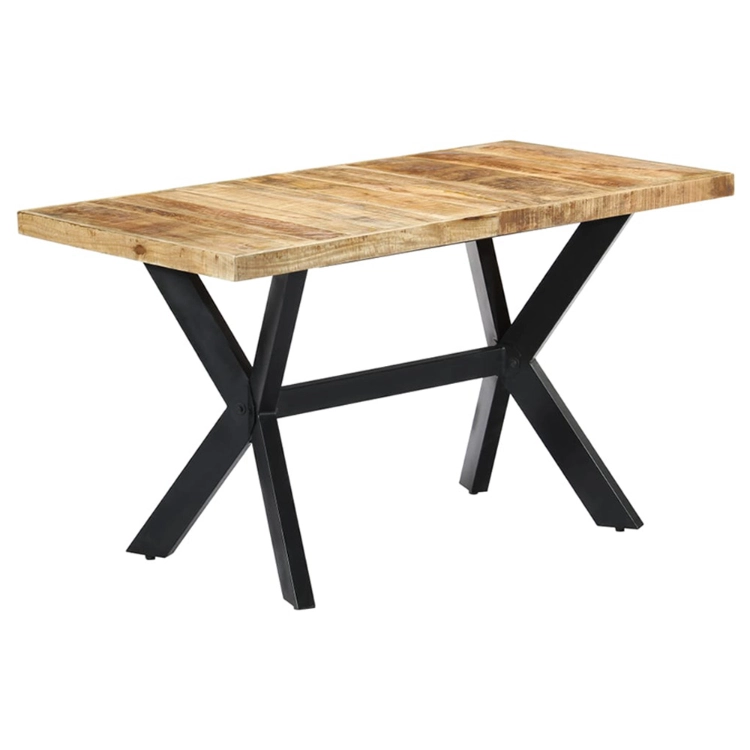
The standard model uses a rectangular wood-look tabletop with a black crossed base. This gives buyers an existing design to evaluate rather than requiring a completely new concept.
At the same time, Hometree lists customization options covering:
These customization options are stated directly on the official HTD0166 product page.
This creates an important middle ground between fully standardized and fully bespoke furniture.
A buyer who likes the existing specification can use the product largely as it is. Another buyer can use the same structure as a starting platform and change only the parts that matter for a particular retail range, restaurant, hotel or project.
This is often how commercial furniture customization works in practice.
Standardized production and customization are not always opposites.
A proven product structure can reduce unnecessary development while still allowing targeted changes that create commercial value.
Custom furniture and mass-produced furniture solve different purchasing problems.
Mass-produced furniture works well when an existing specification already fits the buyer’s requirements and simplicity, speed or market testing matter most.
Custom furniture becomes more useful when dimensions, materials, finishes, branding or project requirements need greater control.
The strongest purchasing decisions therefore compare more than price. Buyers should consider:
Specification → materials → customization requirements → sample approval → production consistency → inspection → packaging → repeat orders.
For buyers evaluating a long-term manufacturing partner, Hometree operates across dining and living-room furniture and supports design, prototyping, production and quality control. More company information is available through the Hometree furniture manufacturer page.
Ultimately, the best production model is not the one with the more premium label. It is the one that gives your business enough flexibility without introducing complexity that the order does not need.
Not automatically. Custom furniture provides more control over specifications, while mass-produced furniture can be more efficient when an existing design already meets the requirement.
Custom furniture allows buyers to modify part or all of the specification. Ready-made furniture normally follows an existing design, material and size specification.
It may involve additional development, but buyers should compare the total sourcing cost rather than the unit quotation alone. Product fit, development, inventory risk, packaging and future repeat orders can all affect the final cost.
Customization is particularly useful when retailers need private-label differentiation, unique finishes, specific dimensions or a product that can be repeated according to an approved specification.
Yes. Production volume does not determine quality by itself. Materials, construction standards, process stability, inspection and packaging have a much greater effect on the final product.
Yes. Customization does not always require designing furniture from zero. Dining Table HTD0166, for example, already has an established design while offering customization for finish, size, packaging and OEM/ODM orders.